An unofficial History of Gators Rugby
July 6, 2026

By Kelley Wiltbank (UFRFC, 1971-74)
Foreword
What follows is an attempt at a history, along with some commentary and a few anecdotes from almost fifty years of Florida Rugby in the rearview mirror. The game came into my life in the spring of 1971. I had come across the Gator Invitational Rugby Tournament while crossing the ROTC Field and stopped to watch and thought "I can do that, just show me how." My initiation came in the fall and I was part of the UFRFC from 1971 to 1974. During that time I played what we were calling "breakaway," served as captain, match secretary and tournament chairman and was on the field with some of the best players, true characters and greatest guys. Having missed the first days, the history of that period is supplied from Phil Whyatt's "The Beginning," George Rozelle's "40 Years of Memories" and Mark McEvers' "Forty Years Ago," each written for the 40th Anniversary in 2009. The remainder is probably infected by memories of memories, with just enough fact to pass as history. In doing so, I wanted to include the names of as many great young men as I could and forget as few as possible. For me, they were all both memorable and unforgettable. Where I have wrongly connected a player with a position, I apologize. Some players may have moved from the backs to the scrum or in the opposite direction, particularly loose forwards. Just remember we had A and B games and sooner or later, whether as a back or in the scrum, each of us probably played them all.
A Milestone Not Contemplated in 1969
It is not unusual for groups across the country to come together every few years to relive a common experience, share memories, mourn the passage of friends, let down their hair some and laugh at how the years have toyed with them. We have class reunions, family reunions, military unit reunions and any number of other gatherings. Florida Rugby has now reached its 50th Anniversary. A milestone not even contemplated in March 1969 when two Aussies, Phil Whyatt and Tony Barker, decided the University needed a rugby club. Now there are five decades of teammates, a part of a continuum that has given it a rich history and experience. Some played only one or two years together, others stayed in Gainesville for much longer, and several met only later as Old Boys, but they each have been a part of the story of the years when as UF ruggers they put on the orange and blue. This is a time to rehash that experience and to hear all of those stories, but most importantly it is the time to remember that there was a beginning and that player by player, game by game and season by season our sport grew, and aided by scores of players, survived its ups and downs and became an established fixture in University of Florida athletics.
At the time not many people in the country were playing the game or had even heard of it, particularly in the South. After approaching the Athletics Department, they learned that start-up sports such as these were the responsibility of the Intramural Sports Department instead. After listening to their pitch, the department director, Dr. Paul Varnes, agreed to support rugby at UF initially by providing two hard-to-come-by rugby balls, some well-worn Gator practice jerseys and most importantly appropriately sized goal posts and a game field that would be marked by his staff to rugby requirements. According to Phil, in a memo written for the 40th Anniversary, the early and continuing success of rugby at the university owes a great deal to Dr. Varnes, who continued to provide the support necessary to purchase rugby jerseys and equipment and provide and maintain the fields for games and practices.
Along with Phil and Tony and a few guys who may have seen a rugby game or maybe played once or twice, they found players for whom the lure of "Give Blood Play Rugby" was irresistible and who came to give this thing a try. Recruitment began with articles in the Alligator and notices in frat houses and dorms and 1000 bumper stickers printed "It takes Leather Balls, etc." Within a few months and leading up to its first games, 20 to 30 guys were showing up to practice, a few at first and then more and more as word spread. The first game was played Friday, November 7, 1969, in Gainesville with A and B games against the newly formed University of Georgia club. The games were at first played on the ROTC field across from Florida Field, and part of the early success was a mishap that had cars parked there on rugby game afternoon by those attending a Freshman football game across the street. When the game was over, due to announcements of "please move your car for the rugby game," there were spectators watching the new sport five deep. The Gators beat the Bulldogs 15-3 in that first ever match. By 1971, games were moved to Norman Field. In the hotter months they were played under the lights. The fighting Gator patch was sketched over beers and continues to the present day.
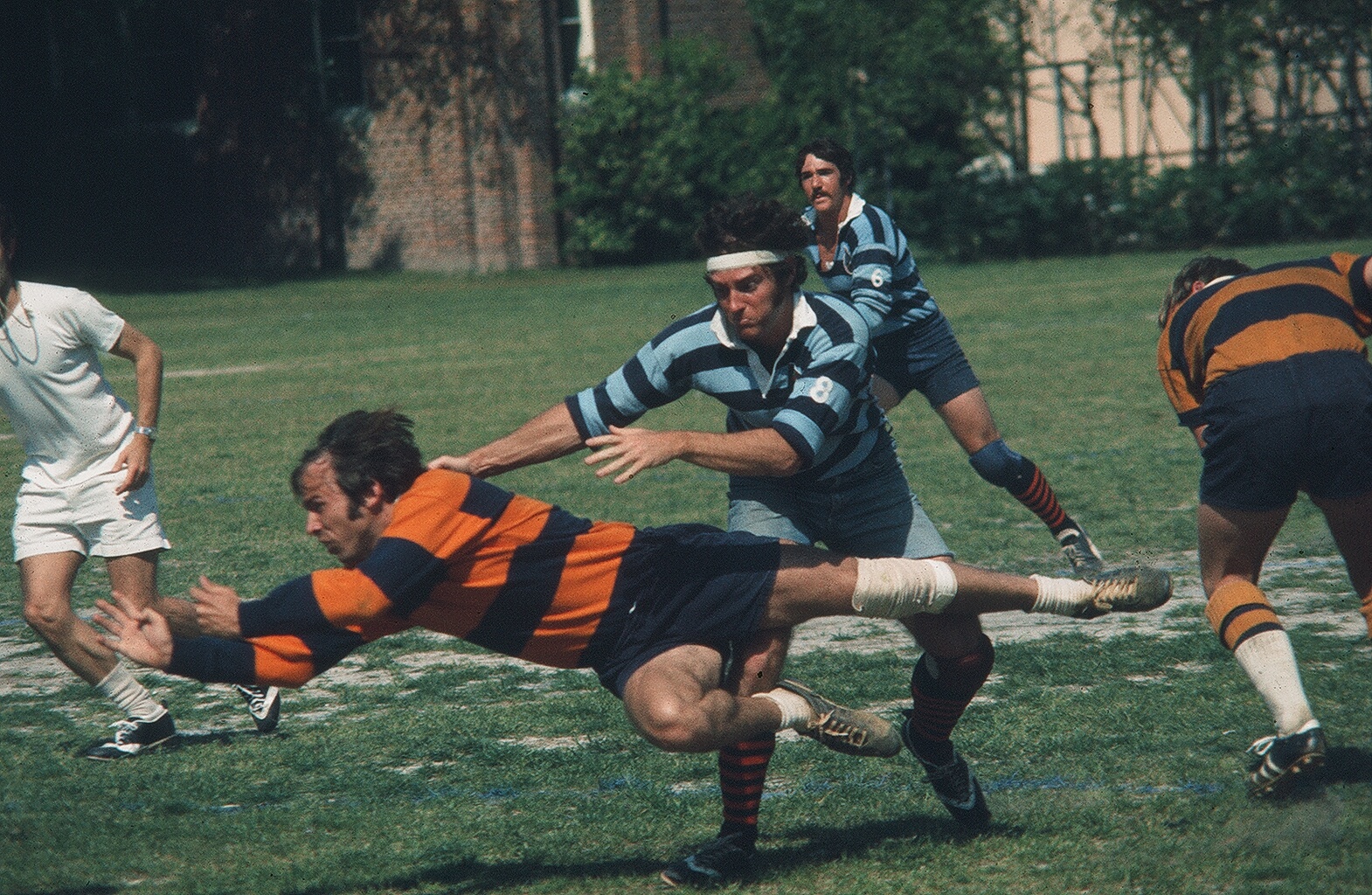
From the beginning, those who joined were athletes who still wanted to play a tackle sport where you could run hard, throw a ball around, and have serious physical contact with an opposition. Some were "tweeners," good athletes at their level but lacking the size, height, speed or some other tangible attribute to move to the next level. Others were "late bloomers" who might have been looked at by colleges if there had been just that little more time or opportunity, or some simply uninterested in any sport until they discovered this one. One of our rivals in those early years said they were just looking for guys and started their club with nine who could be solid shows. When they traveled they borrowed B players from the host team to round out a fifteen man side. You played with who you had and you played them where there was an open spot. Bodies were the priority. Toughness was wanted but rugby skill was just a wish. Initial players to whom present day Gator Rugby owes a debt of gratitude include, along with Phil and Tony, John Apple, "Crusher" Ray and Buck Curtin, John Ebersole, John Geiger, Tom Herriott, Mark McEvers, Rick Meatyard, Storm Richards, Mike Ryschkewitsch, George Rozelle, Charlie Savio, Fred Shaw and of course John Young and Roy Brewer.
This is what us new guys found when we showed up at Fleming Field in 1971 wanting to "Give Blood." I, for one, was sent to the scrum and it was awesome. After an early practice I dropped a wedding gift by the house of a high school friend. It had rained and I was no doubt soaked and covered with mud and blood. His mother later said that was the happiest she'd ever seen me. Being a Southern Lady, she did not say "like a hog in slop," which was no doubt how I looked. In my mind, like others before and after me, I had found athletic Nirvana.
Looking back, you were lucky if you played in the scrum. There was a position for every body type so long as you wanted to run a lot, get knocked to the ground, get back up, butt heads and run some more. There were eight spots to fill, whose names in the beginning were meaningless, like props, hookers, locks or breakaways. If you read the mimeographed handout "How to Watch a Rugby Game," however, you began to know who did what where. With a few instructions and a couple of practices a scrum could come together. With a core already in place in 1971, it was more a matter of fitting in the new guys, raising the skill level at each position, coordinating play and getting a better understanding of the game and how it flowed. In 2009, I put it something like this: "You just chased after the ball until you were able to tackle someone with a different colored jersey foolish enough to still be holding it when you got there."
When I arrived with guys like John Mallow, Brian Burry and Bill Talamas, Florida had a season and a half under its belt. There was a solid but pretty thin core of players who knew how the game was played. Many of the founders were gone, but there were still guys like props Paul Faulkner and Buck Curtin; locks Mark McKeevers, Rick Townsend and George Rozelle, and Greg Mack. They were big and physical with good speed, but there was still a lot of learning to do, much of it by trial and error. I know they would have each liked to focus more on their own skills but they were very supportive and spent much of their time mentoring the rest of us. Fred Shaw was scrum captain. He was not the poster boy of a typical prop. Instead, he was a wiry graduate student, with a bony backside and a vocabulary lost on many of us new and younger guys. Those who were there for practice the day things were just not coming together in the scrum and there was a lot of talking and lack of focus will remember his admonition, "let's have no dissipating in the scrum." I am pretty sure no one knew what he had just said, but it was a good bet none of us was going to get caught doing it.
Turnover was always an issue. Because John Ebersole hadn't returned following seriously breaking his leg at the end of the previous season and Phil was close to graduating, the breaks were open positions. We filled them, until 1974, with Ken Reed and myself. Ted Bujalski and Bill Ware filled in along the way. Storm Richards left as hooker which allowed Brian Burry to step into that role, and when he left "Sixpack" (Dick Lutzenhauser) became, if not a fixture there, at least the best nickname in the pack. He was backed by Gene Janes, who could also play scrum half. Gene was among a number of players recruited from P.K. Younge by Reed, after I recruited him while he was dating one of my sisters. He also brought with him Tommy Brewer, who has unfortunately passed on, and Dan Marvel. All of us were new to the game and there was a lot of learning and catching up to do. Rules would trip you up. Some opponent would make a move you'd never seen or you could spend a lot of time in unnecessary pursuit just to have the ball kicked away. Frustrating at times, but always fun if you kept the right attitude. Fortunately our new coach, John Young, the team captain, and back and scrum captains made it easy to keep a good attitude. They lead by example. There was no giving up among the guys who played for them. They would just show us how to do it better the next time. John told me if I wasn't being called offsides a couple of times a game, I wasn't doing my job.
Interest, jobs, graduations and life were always going to take their toll. Just like our moves from practice fields (Fleming Field, the ROTC field, Sig Ep Field), the earlier group I started with began to move on. They were not easily replaced. They were tough and aggressive and each had considerable good experience. We still had Rozelle and Buck, but the others were replaced by props like Tom Sherouse and George Lutrell, who returned from a short hiatus, Sergio Lopez at prop and 2nd Row, and #8 Gill Ruderman. Each was a front line experienced player or a high level athlete like Serge or Gill. Gill played football at Army and Serge walked on for spring ball with the Florida Football team while still playing for us. The quality of play continued to improve and we would later get former Gators turning out for us. Larry Smith, the former All American and pro running back, played for us in the spring of 1974, and other players like Eddy Moore came and stayed on. Dusty Wolters came to us after playing at FSU. Versatile players like Mike Leonard, Rick Capaldo, Mark Wooten, Mark Witte, and local pharmacist Hal Wilson played wherever they were needed. A rugby season is a long one and to have versatility at all positions was a luxury Florida had, where other teams might not.
Learning the Backs
Gator rugby started with some good backs who, like the scrum, just needed to learn how the game was played. We had some very good backs during this time. Backs, I learned, were the seven players beyond the scrum. I soon learned their names too. Scrum half, standoff (or 5/8), in and out centers, a wing on either side of the scrum and the fullback. The first two were closest to the scrum and put the ball in play. The centers provided the heavy lifting, much like football running backs, and the wings just ran forward as fast as they could. The fullback played behind these six and, like the keeper in soccer, to the uninitiated was responsible for all scores made against us. A coordinated effort was always being worked on. Without it the ball could haphazardly advance but not be dictated by any tactics or strategy and result in plenty of penalties, rucks, and mauls, but no points. In the beginning Fitz Miller and Butch Faulk, the centers, were doing much of the ball carrying. Both powerful, shifty and mobile runners. If you were an opponent, you really did not want to be in the same place where they wanted to be. As Butch and Fitz moved on they were replaced by other talented inside runners such as Jimmy Hutson and Dan Dugan and quick outside runners like Bill Mitchell, my brother Lee, Hugh Quimby, Richard Tolle, Tommy Smith and Rick Kelleher (son of the NFL official). Roy Brewer was the one perennial wing and Cliff Conrad, Raul Garcia, Larry Chisholm, Billy Johnstone, Dave Beutenmueller, and Lenny Schneck complimented him on the other side. Storm Richards had taken over scrum half from Rick Meatyard but he was soon followed by Chip Meador and then Steve Cieplinski stepped up to take his place. Gene Janes ably played there when needed along with Matt (Growler) Frankel and Ralph Ackerman. The 5/8 was Steve Young, backed up by John Young and later by Dan Marvel and Henry Barber, who'd learned his rugby while on a year abroad program in England. John Young played fullback. Howard Robinson and Peter Newfield backed him up.
If the scrum seemed natural, the back line was something else altogether. These players had to learn to do things totally foreign in an American contact sport. On any given occasion at least five of the seven had to move in a choreographed fashion along a sweeping forward moving line. There was nothing to be gained by "five yards and a cloud of dust." If the other team got the ball they could just kick it to the other end of the field and what yardage gained powering it forward was simply erased. No one could help you move the ball farther down the field by knocking or shielding defenders out of your way. To move the ball it was passed or handed off to another fellow back laterally or behind the ball carrier. If the ball moved forward from one player to another you were penalized and lost the ball. This had to be done while at first catching the hand off or pass thrown to you from say 3 to 5 yards away while running forward from someone who was still himself learning how to pass a catchable ball underhanded, laterally or to his behind. If in trying to catch it, it bounced forward off your hands you were penalized and lost the ball. While the pack would spend practice pushing against a mirror image of itself made up of eight other teammates and then practice pursuing the ball up and down the field, backs ran seemingly interminable sweeping lines, trying to pass the ball from one to the next, catching the ball without bouncing it forward off the runner's hands, then having made the catch attempt a similar pass laterally or to the behind. Practice by practice each part of this process improved and it began to look like you had an offense. At this point you would expect the offense could move the ball forward, score points and win the game. Not that easy. This is a competitive sport played by two teams each vying for the ball and to move it in the opposite direction. If a back successfully catches the ball on the run and moves it forward he runs into his opposite number, the guy from the other team placed conveniently in the way who can plant you if the two players meet and the offensive runner still has the ball and cannot effectively elude the defender. The runner must get the ball laterally or back to the next runner in the line, who then finds himself in the same predicament from which his teammate just removed himself. This could go on until a runner has been tackled or all the runners have run with the ball and found themselves laterally out of bounds. It's at this time they have begun to learn not only the skills needed but how to play the game: how to make the other team commit at least two players to one offensive runner, creating an overload so that the next runner moves past his opposite number and down the field if not countered by pursuit from the pack. A back soon attaches great importance to the numbers 6, 7, and 8. One who doesn't does so at his peril. At the beginning this is not easy but with persistence it begins to pay off. Joined with a solid pack, a rugby team is finally developing.
Partying, Practice and a Field Goal
Rugby has a reputation for partying hearty. Many of the best stories begin off the field starting from a good party. Partying and drinking beer were a big part of those early years. But over time, the game truly became the focus. It was during tournaments or trips where you were playing the next day and the host team put on a party that I learned to look for the next team you would be playing. At the Memphis Cotton Carnival, I noticed that the Kansas City Blues, the team we were playing Sunday for the championship, was not there. Its players were still taking care of business and it showed in the game the next day when they showed up rested and ready to play.
The longer I was there the effort to become a better player was taken more seriously. Led by the example of Roy, Tom Sherouse, Gill and Serge, guys began to work out more. We began to have runners and weightlifters. The benefit was not only the strength or endurance but the opportunity to better develop your skills and your level of play. People began to practice skills outside of our twice weekly practices. Guys were practicing pop, squib or drop kicks on their own. They practiced passing on the sideline before and after practice. I even began to give field goals a try. I had two or three balls and I would go to the Gator practice field and kick them back and forth. After a bit I had made enough progress that in a B game at the University of Georgia, as captain, I elected myself the kicker. "Keep your head down," and I didn't on my first two tries and the ball dribbled feebly out in front of me. I was forgiven for those attempts, but when we had a chance for a third and I began setting up, another player ran up, let's just say to convince me not to try another, and let's just also say I waved him off vigorously and attempted my one and last field goal in a rugby game. The first two had been chip shots from dead center. The one I made was from an impossible angle that somehow bent in midair and slid into a two foot window. From then on the kicking continued to be left to John Young, Gill, Bill Johnstone and Steve Cieplinski.
This is an opportunity to mention speed. In rugby it is very important, but just like size and body type, not all speed is the same and not always the same speed is required. There is fast, quick and all of a sudden. First there is fast. Many of our backs were fast, but there is a category of Roy Brewer and Ken Reed fast, immediate zero to top speed. Roy had come from the Florida Track Team, where he ran the 220 and the 440. Reed was a high school sprinter, who for a short while held the record in his division for the high jump. The only difference I saw in the two is that at times I could swear I saw Reed shift gears as he needed to. Then there is quick; scrum halves are quick as are many of your wings. Your centers or power backs are all of a sudden. Someone like Larry Smith, Butch or Fitz, after a move or two deciding what he wanted to do, if it weren't just run over the opponent, the opponent is generally left wondering "how did he do that" as they blew past. Another form of all of a sudden speed is that of the loose forwards and others in the pack. This is the kind where the opponent in frustration generally is muttering to himself "where did that guy come from." Flankers love this one. There is another special speed which few have: slider. John Young is a slider. A slider's speed is deceptive and comes from a long stride which isn't always obvious. John mastered sliding past an opponent who took a wrong angle misjudging his speed. And, of course, let's not forget there is also no speed at all, which is a constant plodding pursuit and pays off when the opponent decides to change directions toward the scrum and runs into a grinning brick wall. Maybe this should be called "heavy metal thunder" instead.
Continuity: Priority One
As the 1970s began, Tony and Phil moved on and the leadership was passed on to others coming up through the team. Continuity was now priority one. Many college sides struggled due to graduation in these early days. A break in leadership, just as one in recruitment, could dictate the survival of a team. Fortunately, John Young as coach was there and became the team's anchor. A universally respected presence, who along with Roy Brewer, as captain, match secretary and tournament director, and Jim McVey guaranteed the club would survive its founders. Jim was unique in rugby at the time. He wasn't a player but a full time referee for our games. He became president of the club. He traveled with us to officiate games and also came to practices to officiate scrimmages. We learned the rules very quickly and played a crisper game because of his dedication. Dr. Mel Fried was the team advisor, number one supporter and great help. There were many others who did their parts during this time. Steve Cieplinski and I followed Roy as match secretaries. My brother and I were tournament directors, again following. Dan Marvel and I followed Roy as captains, but everyone was engaged at this time and guided the Gators through a tough next phase, turning a fledgling club into one that would remain permanent. Although still learning as we went, during this period and beyond players with the UFRFC could truly begin to call themselves ruggers and say "I played for the Florida Rugby Club many years ago" and be recognized for the accomplishment.
No Kit, No Bus, No Problem
Because of the limited funding for the rugby club, we each paid dues. What money we received still came through the Intramurals and Sports Department. While mentally we were playing college athletics, the most obvious equipment of being part of it was not yet made available. There was no rugby kit. Going through the early team photos, other than a jersey we wore a mismatch of whatever we had or felt comfortable in. If you played in the B game you wore someone's sweaty jersey. A jersey which had no business being worn in the South, except for tradition. Because the jersey always seemed to shrink, particularly in the sleeves, it was natural to cut the sleeves at the elbows. It made them at least a little cooler. The collars were constantly being torn and ripped open, leftovers from grabby opponents. In my first year I wore blue jean cut offs and as the seams ripped a little further I just taped them together. From there I graduated to cut off UF football pants my brother somehow commandeered. Only a couple of people had actual rugby shorts. Fast guys, like Roy and Ken Reed, always seemed to have over the calf socks, and were therefore particularly stylish. Socks became a little more uniform when knee high athletic socks became the campus style and you could find them in the stores. There were no boots. Soccer shoes seemed the best alternate choice. One season I wore ankle high canvas topped Converse athletic shoes with cleats, compliments of the US Army. Until Leather Balls, Inc., the first company specifically dedicated to rugby wear and sundries, came upon the scene, any extras were purchased from itinerant sellers who seemed to set up shop out of nowhere at tournaments, or from Jimmy Hughes Sporting Goods on University Avenue. These were mostly T-shirts emblazoned with "Give Blood" or "Keep on Rucking." We would often trade T-shirts with visiting teams. My favorite was one from Michigan State.
The lack of funding carried over to hosting visiting teams and to our own travel. In the early years hosting included the after game party and food as well as help in finding places for players to stay. Teams were not making accommodations for themselves yet. Our players would find an extra bed or room at their dorm, fraternity house or apartment. Sometimes it meant sleeping on the floor. Particularly during tournaments a visiting player could find himself on the floor of a gym or on a cot in the basement of the recreation department. For the first few Gator Tournaments quite an amount of time was spent arranging with the Housing and Recreation departments for just such accommodations. Knowing what to take with you when traveling was important. If we were traveling to the Pensacola Navy Air Station it wasn't a problem because we were playing against officers and we could be put up in the Bachelor Officers Quarters. At the Eastern Rugby Union Championship at Washington and Lee University we were on the floor of a gym. At Tulane, it was the floor of a high rise dorm. A back at Georgia who called himself "the little fat boy" let us sleep on his apartment floor. At LSU we slept on bunks in the old athletics dorm underneath the stadium. Until we started sharing rooms at a Motel 6, or the like, sometimes four or more to a room, we learned to bring our own sleeping bags, pillows, blankets and towels as part of our equipment.
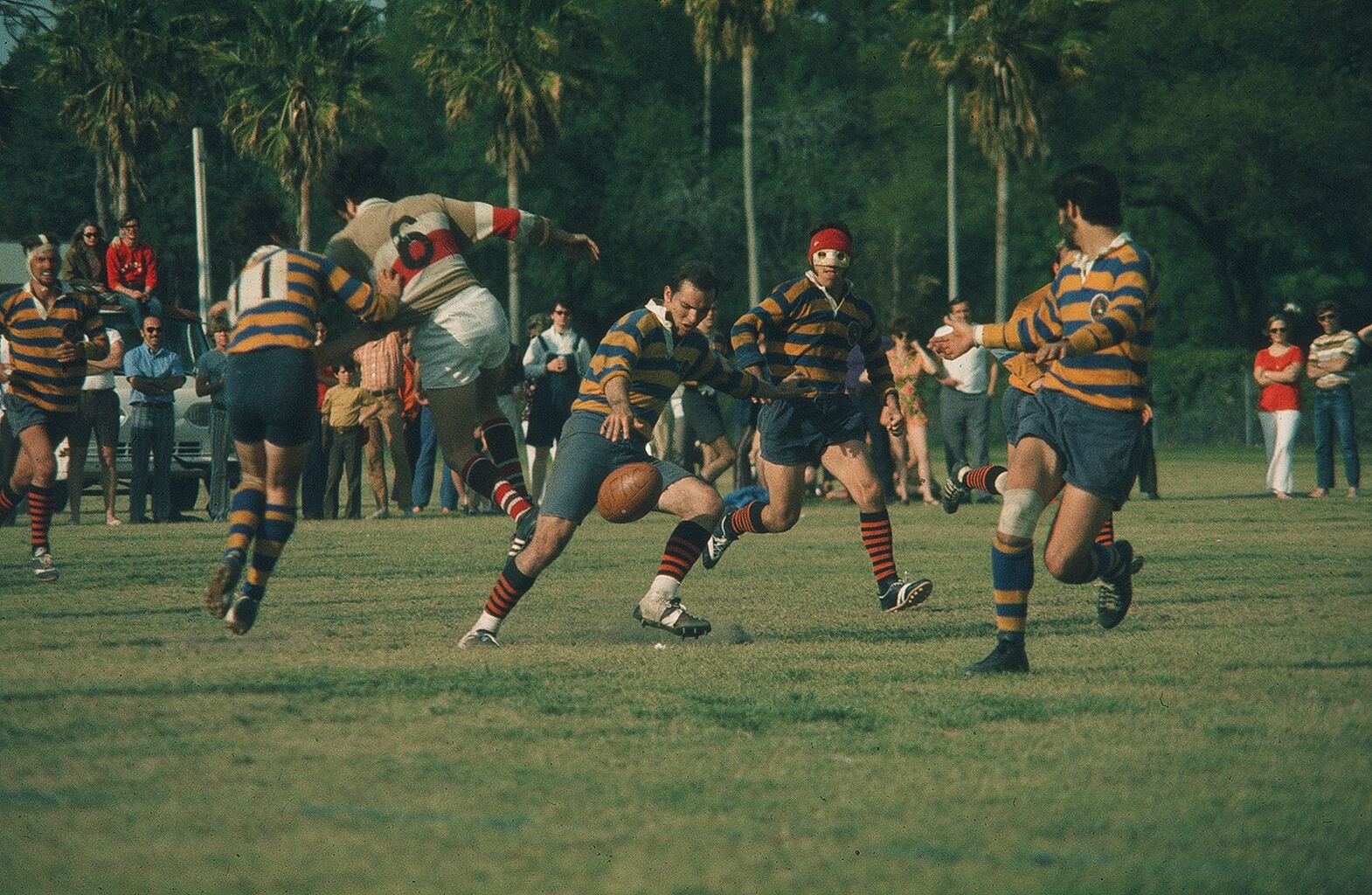
There were no team buses or vans for larger group travel, just enough cars to get at least 15 or more guys to where we were going to play. There were no car assignments either. Each player had to make sure he had a way to get there. You generally traveled with whom you were comfortable, but scheduled departures and returns were mostly dictated by whose car you went in. Most travel was down and back in the same day because we were getting enough competition within a four or five hour drive. If you scheduled a stay over it was either for a tournament or a game scheduled for both days of a weekend. During the 1971-74 time period, in addition to Florida, we had teams in Jacksonville, Orlando, Tampa (South Florida), Naples, two in Miami (Miami RFC and the Tridents), FSU and NAS-Pensacola. In Georgia there were the two Atlanta teams (Atlanta RFC and the Renegades) and the University of Georgia. We also traveled out of the area. We had trips to Baton Rouge to play LSU, the Mardi Gras Tournament at Tulane, the Cotton Carnival in Memphis, the Eastern Rugby Union Finals in Lexington, Virginia, Nashville for the SECs, and the Borderers Tournaments in Windsor, Ontario, across the river from Detroit. Mostly all the first side got there on time but there were a few close calls. On a trip to Atlanta, somewhere north of Macon, we passed several teammates on the side of the road with car trouble. We loaded them into our car and headed on to the game. Who the players were, and what happened with the car, is a faded memory now, but needless to say, that many bodies in one sedan became a little crowded so my brother rode on to Atlanta in the trunk. I believe it was on a separate trip to Atlanta where for a period we had to stop every 30 or so miles to let Ken Reed out to stretch his thigh muscles which kept cramping on him. It is surprising there weren't more flat tires, over heated engines, or break downs, especially because of the cars most of us had to drive. One player actually brush painted his car. Even when we upgraded to something better there was no guarantee of a problem free trip. Gill borrowed a Winnebago for the first SECs in Nashville. A half dozen of us rode up with him. Somewhere on the north side of Atlanta the Winnebago began to have engine trouble. After we'd pulled over we discovered the hidden talent of one of the newest guys on the team as he was up to his backside working on the engine and had us running again. After saving us like he did I know we felt badly we didn't play him at the tournament. On the first trip to Windsor five or six of us rode there in a 3 seat station wagon. We decided to drive I-75 straight through. We had a radio and an 8-track for entertainment. Back then you might not always be able to pick up a clear radio station so we'd listen to repetitious hours of music on the 8-Track. On a pit stop late in the evening on the way back, tired of the repetitious music we had, one of us bought a tape of country music. This was the real thing: Hank Williams, Ernest Tubb, Dolly Parton, etc. It turned out that Roy had such an aversion to country music that he would have given away all his secrets if he had to listen to much of it. Realizing he was trapped in the third seat, that tape was played non-stop until it was no longer fun to torment him.
Not all travel was miserable. You never can tell just what a trip might bring. We traveled to Miami the weekend of the 1973 Super Bowl. When one of our teammates invited us to stay over to watch the game, that left me without a ride back for my job that Sunday afternoon. While wondering if I were going to have to hitch hike back overnight, one of our newest players, Ted Bujalski, offered me a ride back with him from Ft. Lauderdale the next morning. If we left early enough that would get me back on time. After a great evening meal, a good night's rest, and a big breakfast, I began to wonder if we would actually make it. His dad always had another errand to run or some other little thing to do. Finally, when I was about to write off getting to work on time, we drove to the local general aviation terminal, hopped into his plane and listened to the game all the way back home.
Travel could have its good times. Needless to say Mardi Gras was exciting, and in Nashville several of us went over to the old Ryman Theater to watch them televise a couple of episodes of the Grand Ole Opry. We saw Marty Robbins and Minnie Pearl, among others, that night. You also never can tell what excitement might come your way if you just happen to be Johnny on the Spot. On my first away trip to LSU, Fred Shaw managed to get a couple of tickets from fed up Gator fans leaving at halftime. We were staying in the old athlete's dorm under the stadium and three or four of us were just standing around. Fred grabbed me and we found ourselves in the Tiger end zone. Expecting the worst, I kept my head down as Fred vigorously cheered the Gators on. Fortunately, the fans around us took to him (since we were losing pretty badly) and we had a great time.
It was playing rugby for Florida where I learned that I actually had hamstrings. I spent the rest of my playing days doing pre-stretch before I could even begin to stretch. If you have never pulled a hammy, it is like driving along at 60 mph and having a blowout. You can just feel one of your wheels no longer propping you up and almost hear the thump, thump, thump as you roll to a stop, except with a little more pain. It was then you wished you played for Palmer College, the chiropractic school that attracted many South African rugby players and was a perennial early powerhouse. To watch the response to an injury to one of its players was a treat. Fourteen other guys would seem to ruck over him, lay their hands on the injury and voila, he was up and running again. No knock on our med students, like Howard Robinson, who played the centers for us when he had time, or pre-med Ross Zeanah, who we later lost in a car accident, but the laying on of hands approach appealed to many of us.
A Family Affair, and a Changing Game
We had started with a few graduate students but as we got older as a team, Florida rugby began to take on a bit of a family affair. Buck Curtin would routinely have his three children with him. One of his goals was to play until he could be on the same team with his son. Hal Wilson, a local pharmacist, would occasionally load his kids in his station wagon for an away game. I rode with them on at least one occasion and there was no doubt they were better behaved than some of the other cars I'd been in. With the advent of the Old Boys, more fathers adopted the goal of one day playing on the same side as their sons.
Over the years the game itself has changed subtly. From the perspective of the rearview mirror, it is faster and stronger, not the players themselves, but the pace and what is allowed by the rules. Clearly lifting in the line out is a rule change. But interpretations of the rules have it flowing more rapidly. Unless the fouling team is gaining an advantage, things such as releasing the ball, lingering, hands-in or failure to bind aren't penalized as readily. The most striking is in the ruck. The one from the bygone era seems to have disappeared. A constant bark to the pack from Phil was "show 'em your rear," setting up the ruck. The ball carrier did a 180 and his teammates bound on either side of him, forming a wedge blocking the opponents through which the ball was either passed or handed back to the scrum half. Everyone had to be bound and a player could join only from his side of the ball. Many of us lived for the ruck, or the fake ruck. If during the 180 the ball carrier noticed the other side was not binding quickly or appropriately enough, he would simply hand it or pass it off to a teammate running by him before the ruck was formed. Sometimes the subtleties are as important to the game as the flashy play. The only time I was ejected from a game was in forming a ruck. A player from FSU bound rather purposely into my back, about which I had some unkind feelings. It was in the remaining minutes of a game we lost 63-3 (does anyone remember the Netter brothers) and there may have been some method to my madness.
My Senior Class Photo
So many of us have come and gone. If the 50th Anniversary is to mirror those other reunions and gatherings, the team picture from the second Borderer's Tournament is, for all intents, my Senior Class photo. After it was taken Ken Reed drove me to the Detroit Airport where I got on a plane headed for the rest of my life, which included rugby in Spokane (Gonzaga University) and Boise and my only contact with an FOB, Perry Dempsey, who was not only a good friend, but a great coach and teammate with the Boise Motherlode RFC.
More News
.png)

Lorem ipsum dolor sit amet elit
Lorem ipsum dolor sit amet, consectetur adipiscing elit, sed do eiusmod tempor incididunt ut labore et dolore magna aliqua. Ut enim ad minim veniam, quis nostrud exercitation ullamco laboris nisi ut aliquip ex ea commodo consequat. Duis aute irure dolor in reprehenderit in voluptate velit esse cillum dolore eu fugiat nulla pariatur.

Stay Connected
Gators Rugby is more than a team. It's a community of players, alumni, and fans who care about this program. Stay connected and we'll keep you in the loop on everything happening on and off the pitch.