Every program has an origin story. Few are as unlikely as this one.
Gators Rugby did not begin with a coach's vision or an athletic department initiative. It began with two Australians, a rain delay, and a very boring game of cricket.
A Cricket Match and an Idea
In March of 1969, Tony Barker and Phil Whyatt were standing around during a UF versus FSU cricket match in Tallahassee. Cricket, as any Australian will admit, involves long stretches of standing around with nothing to do but talk. Somewhere in that conversation, over a beer, Tony and Phil decided that what the University of Florida really needed was a rugby club.
It was not an obvious idea. In the American South of 1969, almost nobody had heard of rugby. The sport had a foothold in a handful of Ivy League schools, a few military programs, some cities with large expatriate communities, and a corner of California. It had never made it south. Tony and Phil set out to change that.
The following Monday, the two men walked into the Athletics Department and asked for support. They were quickly redirected. Head football coach Ray Graves passed them along, and they bounced from office to office until someone finally pointed them toward the Intramural Sports Department, an office that at the time was mostly known for organizing fraternity flag football and tiddlywinks tournaments.
Finding a Home
That meeting turned out to be the one that mattered. Dr. Paul Varnes, head of Intramural Sports, had never seen a rugby match in his life. He told Tony and Phil, not unreasonably, that he expected the whole thing to be a "five minute wonder." Student interest came and went, and he had watched plenty of new ventures fizzle out.
But he said yes anyway. Dr. Varnes agreed to back the fledgling club with two rugby balls (not an easy thing to track down in Gainesville in 1969), a stack of worn out Gator practice jerseys, and, most importantly, a field marked out to rugby specifications with goalposts installed. It is hard to overstate how much that single decision mattered. Every account of the club's founding, from Phil Whyatt's own retelling to Kelley Wiltbank's 50th anniversary history, credits Dr. Varnes as the reason Gators Rugby survived its first year, let alone its next five decades.
Recruiting an Army
With a field and a couple of balls, Tony and Phil still needed players. Recruitment ran through the pages of the Alligator, flyers tacked up in fraternity houses, and a stunt that could probably only have worked in 1969: a thousand bumper stickers printed with the phrase "It Takes Leather Balls." Provocative for Gainesville at the time, and exactly the kind of talking point a brand new club needed. The stickers ended up everywhere.
Twice weekly practices closed out with trips to the Red Lion or the Thirsty Gator, where showing off in front of a few dozen curious onlookers turned out to be its own recruiting tool. Word spread. A handful of guys at the first practice became 7, then 20, then 30 within a few months, many of them poached straight off the UF soccer practice fields nearby. Rick Meatyard, who would go on to anchor the scrumhalf position for Florida's first few seasons, was one of those early soccer converts.
The First Match
On November 7, 1969, Gators Rugby played its first game.
Two Kiwis from the University of Georgia, Graeme Holloway and Brian Finch, had started their own club slightly earlier and agreed to bring their team to Gainesville for A and B side matches. The game was set for what was then called the Gator Practice Field, right next to Florida Field, freshly marked out for rugby just for the occasion.
What nobody accounted for was the Florida versus Georgia freshman football game happening that same afternoon, right across the street. Fans looking for parking simply pulled onto the newly striped rugby pitch. Five hundred cars sat where the match was supposed to be played.
What happened next became the founding legend of the program. Someone in the press box at Florida Field, in an unmistakably Australian accent, cut into the freshman game's broadcast to ask the crowd to move their cars because a rugby match was about to start. Confused fans obliged. Nobody left. By kickoff, spectators were standing five deep along the sideline, watching a sport most of them had never heard of. They cheered, groaned at the contact, and by all accounts loved every minute of it.
The Gators beat Georgia's B side 15-3 that day. It was the first result in what is now more than fifty years of Gators Rugby history, and it happened in front of an accidental audience of a few thousand people who showed up for football and stayed for something stranger.
The Georgia club deserves real credit here too. They traveled to Gainesville with only 22 players total for both A and B games, which meant plenty of their own guys played both matches so Florida's brand new club could actually take the field. Florida's own preparation was similarly makeshift. The referee for the A side match had been pulled out of the UF library three days before the game. He had never played rugby, had only watched it on television in Melbourne a handful of times, and was coached through the rules mid-match by Florida's own captain.
From Two Balls to a Tradition
The publicity from that first match, picked up by both the Alligator and the Gainesville Sun, kept the momentum going. By February of 1970, just months after that first game, UF Rugby traveled to its first tournament, the Mardi Gras Tournament in Baton Rouge, with about 20 players making the trip in a van provided by the Intramural Department.
The Intramural Department kept supporting the club as it grew, funding jerseys and equipment. It was during this period that the fighting Gator patch, still worn on jerseys today, was sketched out one night at the Handlebar Lounge over a few beers. It has stayed essentially unchanged ever since, a small piece of art with a very on brand origin story for this club.
By 1971, games had moved to Norman Field, and in warmer months matches were played under the lights. What started as two guys, two balls, and a borrowed field had become a real program with a real home.
The Rugger Huggers and an International Debut
Rugby clubs of that era ran on more than just the players, and Gators Rugby was no exception. Peggy Barker, Tony Barker's wife, and Delis Whyatt, Phil's wife, started what became known as the Rugger Huggers, the partner support and cheer squad that showed up in bright orange t-shirts with navy lettering and joined in on the rugby songs, risqué lyrics and all, much to the surprise of the more reserved Southern crowd around them.
The club's social life matched its on field ambition. The first road trip took the team to Hammond, Louisiana, where players wandered the motel hallways calling out for "Wombat," the traveling codename for Tony Barker. And in an early sign of how far this scrappy club was willing to travel, Gators Rugby played its first international match in the Bahamas, staying in a hotel that happened to be hosting Howard Hughes and the Rolling Stones at the same time. Rick Meatyard reportedly found himself standing next to Mick Jagger at the casino.
Not every trip made for a good story in the moment. One infamous team picnic in the swamps outside Gainesville ended with a hornet's nest, a swarm of mosquitoes, and more than one player too sick to make it to work the next day.
Building Something Permanent
By the time Kelley Wiltbank joined the club in 1971, the founders were beginning to move on, but the culture they built held. Wiltbank's own account, written for the club's 50th anniversary, captures a program in transition from scrappy startup to lasting institution.
Turnover was a constant threat in those early years. College players graduate, and a club with no full time coaching staff could easily have folded the moment its founders left campus. It didn't, largely because of two men: John Young, who took over as coach and became what Wiltbank calls the team's anchor, and Roy Brewer, who served as captain, match secretary, and tournament director all at once. Jim McVey, who wasn't a player but a full time referee, became club president and traveled with the team to officiate games and scrimmages, helping the Gators learn the rules faster than most young clubs manage.
The equipment situation stayed threadbare well into the 1970s. There was no official kit. Players wore whatever jersey fit, cut the sleeves off to stay cool in the Florida heat, and in Wiltbank's case, played an entire season in cutoff blue jeans held together with tape before graduating to cutoff football pants scavenged from his brother. Travel was just as improvised: no team bus, just enough cars to get 15 or more guys wherever the game was, with players sleeping on gym floors, dorm room floors, and once, memorably, in the basement of a recreation department.
What held all of it together was the rugby itself, and a culture of mentorship that Wiltbank describes as central to how the club survived its growing pains. Veteran players like Fred Shaw, Mark McKeevers, and George Rozelle spent as much time teaching the fundamentals to newcomers as they did playing their own positions. It is a pattern that shows up again and again in the club's early history: the guys who had it figured out made sure the next generation did too.
A Program the Community Noticed
By 1973, Gators Rugby had grown enough to warrant its own feature in the Independent Florida Alligator, headlined "An Animal's Sport Played by Gentlemen." Club president Jim McVey and tournament chairman Kelly Wilbanks told the paper that rugby offered something football couldn't: a game that didn't end when you left campus, open to players regardless of size, age, or background. The club's roster that year ranged from 19 to 38 years old. A full season stretching from September to May, sponsored tournaments, and a home schedule against schools like North Carolina State made clear this was no longer a five minute wonder. Four years after Dr. Varnes made that skeptical bet, Gators Rugby had built exactly the kind of staying power he doubted was possible.
Honoring a Founder
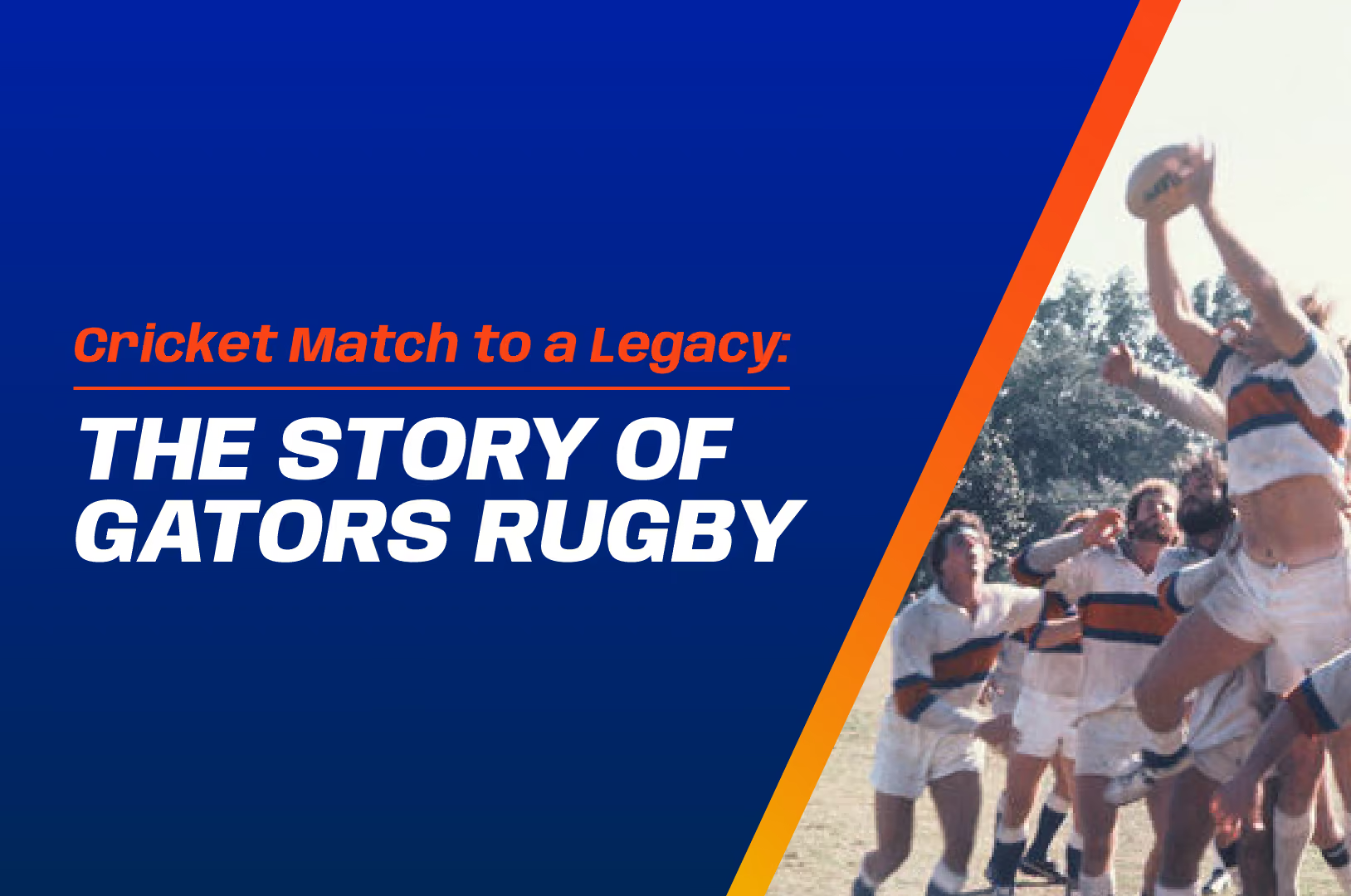
Tony Barker passed away in October of 2006. At the club's 40th anniversary celebration in 2009, Peggy Barker traveled from Australia to represent him, bringing with her a tribute that captured just how far the sport had traveled with the man who helped start it in Gainesville. She commissioned a bronze sculpture of Tony mid try, based on an action photo taken on Norman Field in 1970, and unveiled it earlier that year at Baldina Station, the family's sheep property in the South Australian outback. The bright orange UF Rugby windcheater jacket the club gave him decades earlier had also made the trip home, worn on the ranch as he rode down the hills on his motorbike, a small flash of Gator orange in the Australian outback.
A Legacy Still Being Written
What began as a conversation between two Australians during a rain delay has become one of the longest running club sports traditions at the University of Florida. The founders who talked their way past a skeptical athletics department, the Intramural director who took a chance on two rugby balls and a marked off field, the players who wore taped together cutoffs because there was no such thing as a rugby kit yet, and the Rugger Huggers who sang the songs just as loudly as the players played the game: all of them built something that was never supposed to last past a semester or two.
More than fifty years later, it still does. Every Gators Rugby player who takes the field today, in the Men's or Women's program, is playing in a tradition that started with a dare, survived on borrowed equipment and pure stubbornness, and grew into a permanent part of what it means to be a Gator.