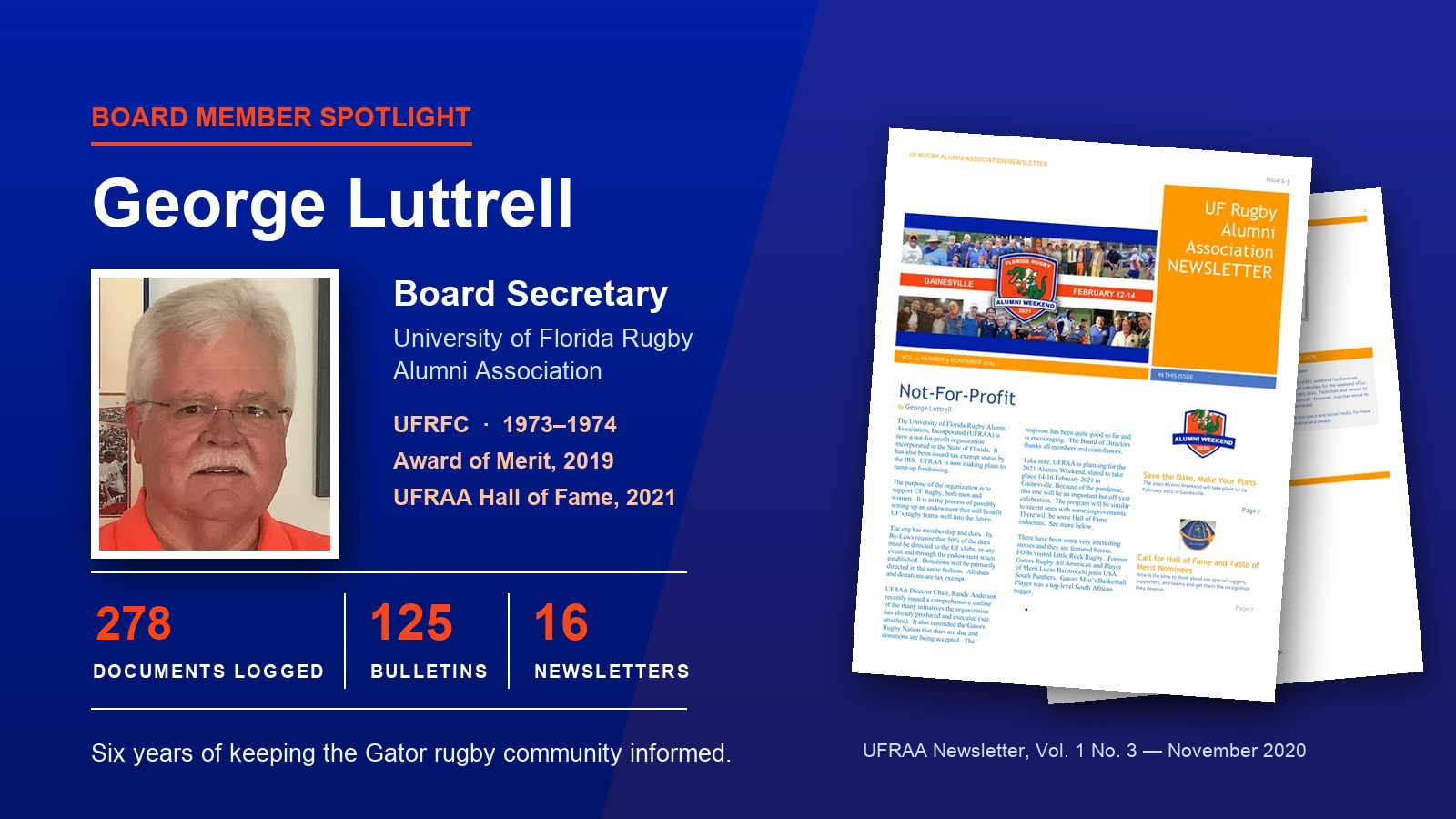
This is the first in a series on the people who serve on the board of the University of Florida Rugby Alumni Association — what they do, and what the club has because they did it.
It starts with the Board Secretary, for a simple reason. If you have received anything at all from this association in the last six years — a newsletter, a bulletin, an email telling you that somebody had passed — then you have already met George Luttrell. You may just not have known his name was on it.
George played for UFRFC in 1973–74. He is the association's current Board Secretary, board class of 2029. And for six years he has been the reason the Gator rugby community knows what is going on.
Six years, 278 documents
The association keeps a document log. Every conference note, corporate notice, newsletter, bulletin, memo and email it has ever issued, each one given a number, a date and a status. It is the kind of thing that exists only when somebody decides it should exist and then maintains it for years without being asked.
As of this week it runs to 278 entries.
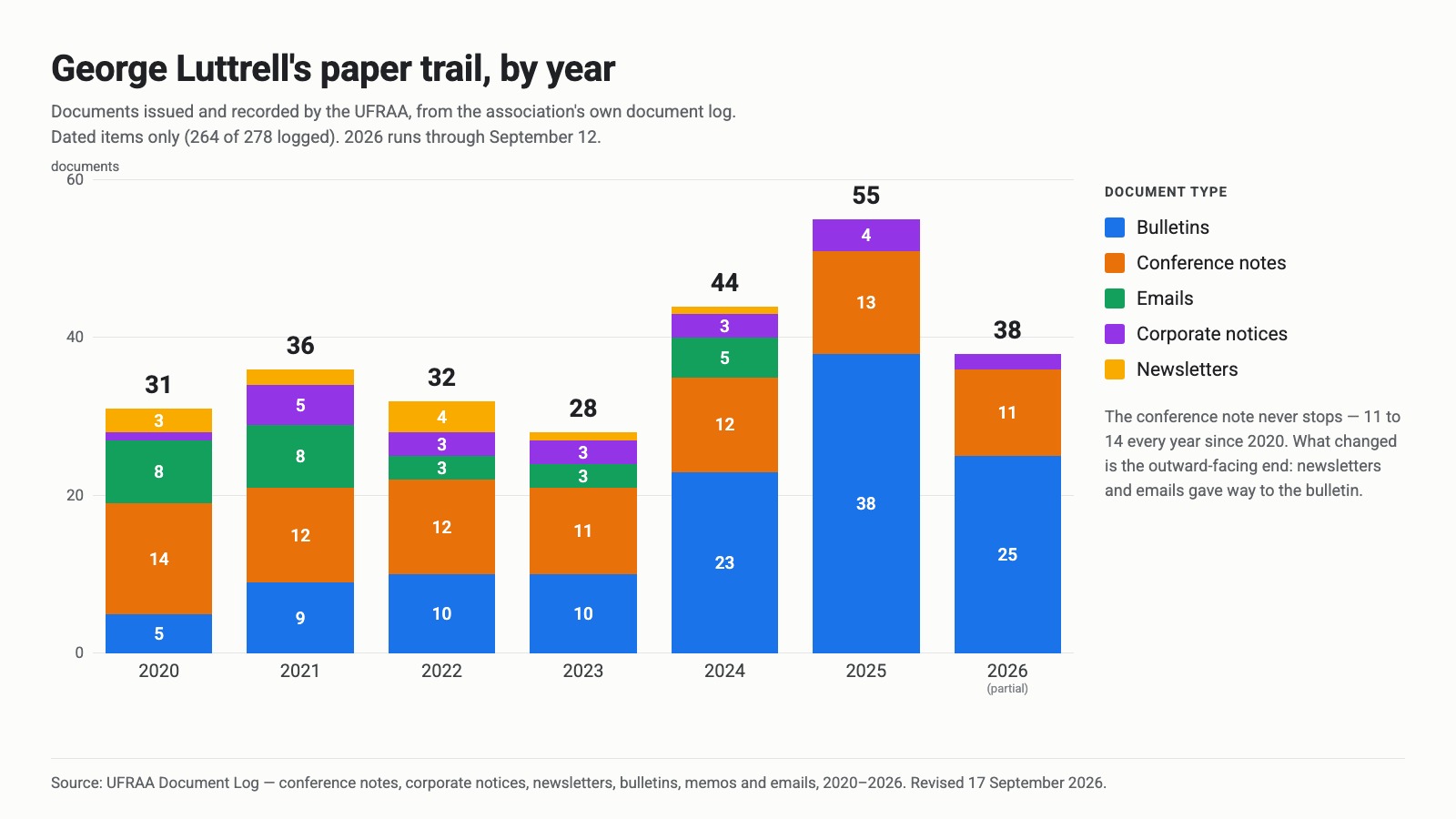
The breakdown: 125 bulletins, 87 conference notes, 28 emails, 21 corporate notices, 16 newsletters, and one memo. The earliest dated entry is a conference note from 13 January 2020. The most recent is Bulletin BN-26-22, issued 12 September 2026.
That last one matters here for a specific reason. BN-26-22 is the bulletin that carried the news that Steve Cieplinski had passed ad astra. The memorial that ran on this site was written from it. That is less a coincidence than the whole pattern in miniature: when this club knows something, it generally knows it because George sent it.
What one of his newsletters actually looks like

Take Volume 1, Number 3, from November 2020. Twenty-two pages: nine pages of newsletter and thirteen pages of attachments behind it.
The lead column is his own, bylined By George Luttrell, and it announces that the association has been incorporated as a not-for-profit in the State of Florida and granted tax exempt status by the IRS. It is written the way he writes everything — short paragraphs, no adjectives doing work that facts should be doing, the mechanics of dues and donations explained in plain sentences so nobody has to ask.

Turn the page and the byline changes. The fundraising column belongs to Randy Anderson and runs under his name. The Little Rock story points readers to a letter from Roy Brewer, printed in full further back. This is worth noticing in a club newsletter, where the easy thing is to absorb everyone's material into one anonymous editorial voice. George does the harder thing and keeps other people's names on their own work.
The house style: show the document

When a former Gators All American joined a coaching staff, George did not write a paragraph about it. He reprinted the press release in full, dateline and embargo time intact, and let it speak.
That is the defining habit, and it runs through all 278 documents: he does not summarize a thing when he can show you the thing. Volume 1 Number 3 carries the membership dues ledger, name by name. A four-page first-person letter from Roy Brewer about the Florida Old Boys trip to Little Rock, including a club-history timeline kept by somebody else entirely. The Hall of Fame roster. The Award of Merit roster. Forwarded email threads with the headers left on.
The effect is that you cannot really argue with one of his newsletters. The claim and the evidence turn up in the same envelope.
The register
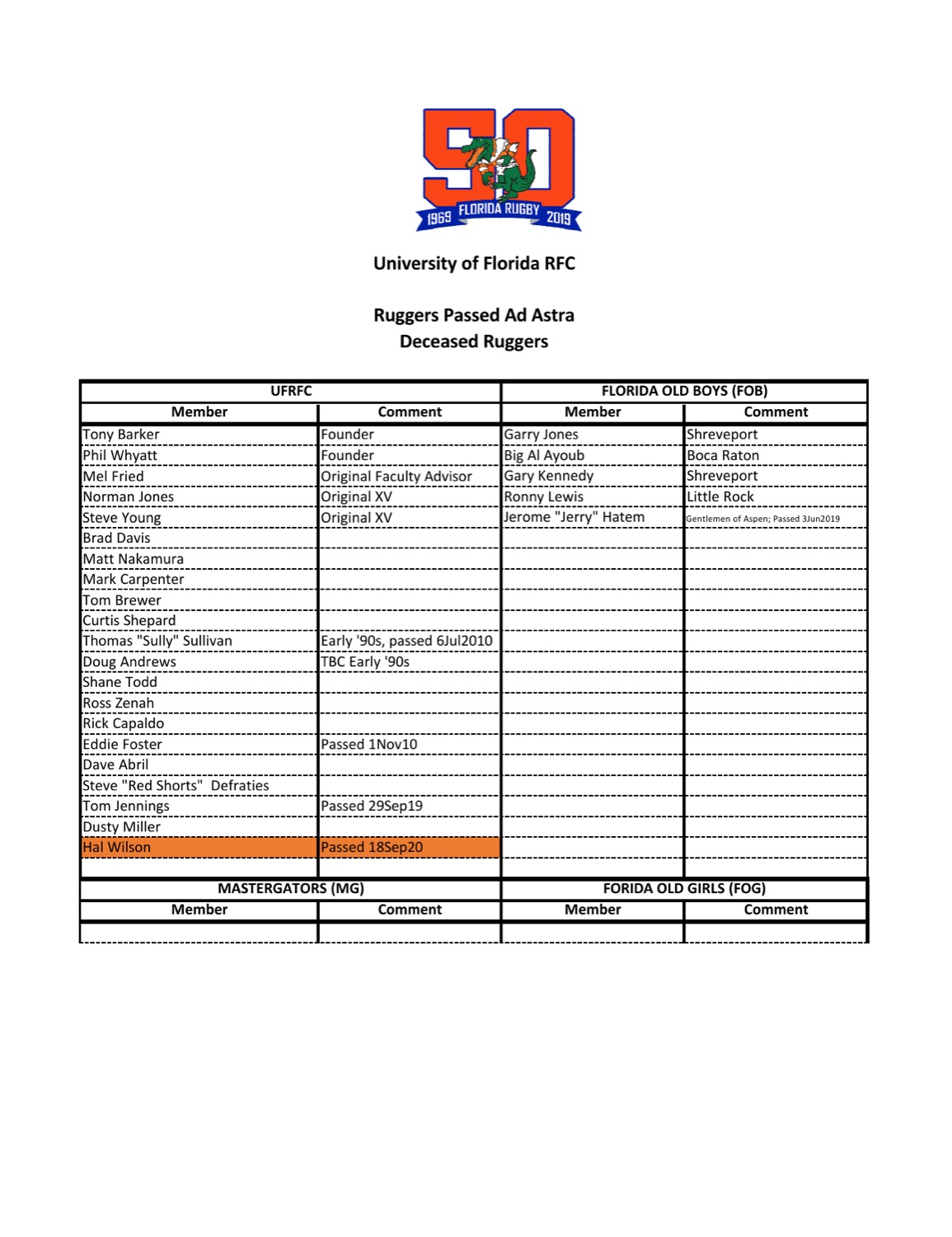
One attachment in that issue deserves singling out. It is headed Ruggers Passed Ad Astra, and it lists the club's dead: UFRFC in one column, the Florida Old Boys in another, MasterGators and Florida Old Girls beneath. Founders. Members of the original XV. The first faculty advisor. Dates of passing where they are known, and blanks where they are not.
It is a plain table in a plain font, and it is one of the more important documents this club owns. A club that does not keep this list loses these men twice: once when they die, and again about fifteen years later when nobody left can remember who they were.
George was keeping that register in 2020. He is still the one sending that news out in 2026.
He is on the lists he keeps

Also attached to the back of that newsletter is the club's Award of Merit roster. Index 5 reads: George Luttrell, recognized 16 February 2019, citation — “Extensive UFRFC/FOB/Rugby Leadership.”
He typed that page. He attached it to a newsletter he wrote, laid out and sent to the entire membership. And he did not mention it anywhere in the newsletter.
The following year the club put him on the other one as well: George was inducted into the UFRAA Hall of Fame in 2021. Both of the rosters he attached to the back of that November issue now carry his own name.
From the newsletter to the bulletin
The chart higher up this page shows a genuine change in method, not just a change in volume.
In 2020 and 2021 the association was talking to itself in four formats at once — conference notes, newsletters, emails, bulletins — more than thirty documents a year. What changed since is the outward-facing end of that. Emails taper off after March 2024. The last newsletter in the log is Volume 5, Number 2, from November 2024.
What took over is the bulletin: 23 in 2024, 38 in 2025, 25 already by mid-September 2026. A hundred and twenty-five of them all told.
The one line that never moves is the conference note. Eleven to fourteen a year, every year since 2020 — the record of what the board actually discussed, kept whether or not anybody asked to see it. It is the least visible thing in the log and the longest unbroken run in it.
That is a deliberate trade, and it is the right one. A twenty-two page newsletter is a magnificent object that takes weeks to assemble and lands three or four times a year, by which point half of what is in it has happened. A bulletin is one thing, said once, sent the day it matters. For an alumni body that scattered across the country decades ago, the second beats the first almost every time.
What did not change is the numbering. BN-26-22 is the twenty-second bulletin of 2026. It sits in the log beside the other 124, dated and findable, which is the entire point.
Why this is the foundation
This club is in the middle of putting itself online — the new site, the news archive, the history and honors pages, the schedules, the alumni program, the student marketing internships starting this fall.
None of that generates its own past. An organization can only publish what it kept. Six years of numbered, dated documents, each with its sources attached, is precisely the raw material that makes any of this possible, and it exists because one man decided that what happened to this club was worth writing down, and then did it 278 times.
Most of that work is invisible by design. A good secretary's output looks like everyone simply knowing things.
So: thank you, George. From everybody who found out because you told them.
This is the first in a series on the UFRAA board. More to come — and if you serve on the board, or you know someone whose contribution belongs in it, get in touch through the contact page.
Go Gators. 🐊